
Note: Thank you for being on this AI journey with me. These are my candid reflections before heading out for summer vacation. If you liked it, please share with a friend or colleague!

Some nights as a young associate I stayed up till 4 a.m. fiddling with Word tables, running mangled redlines, circling numbers by hand to scan into a PDF.
That work was, in a word, dumb.
Fast forward to late 2025. With AI agents I saw a future where the category of dumb work breathes its last. An agent could do those tasks in minutes, if not seconds.
Those coding agents came out of the engineering world, and I’ve always felt a kinship with engineers. Like us, they live in logic and precision. This year our two worlds collided even more. Agents were marketed for coding, but they could do so much more: reason, design decks, crawl documents, build websites and apps. And through the medium of software code, they could control the computers where all modern work happens.
In January I began talking about AI publicly, and there I started with an idea lifted from engineering: 10X productivity as an AI-native lawyer.
I adapted coding workflows to law, and it felt like magic. It gave new meaning to a quote I’m fond of:
Engineers and lawyers do similar work, except that lawyers work in lower-quality code.
Limits of the AI frontier
But as a product lawyer, after months of tinkering with AI day and night, I’ve also seen the limits our profession faces.
I dare say most engineers I know don’t read code anymore. I know engineers who run 80-hour coding loops with ten or more agents at once. Think about that. Software engineers live in a world where they don’t have hands on the raw thing they once made.
I’ve tried that with law and, spoiler alert, it’s still just a peek at the future. As of June 2026, it’s not quite yet the fundamental revolution we’ve seen in engineering. Sure, I can run a fleet of agents overnight on some multi-jurisdictional regulatory analysis. I can have them read a few gigabytes of documents and index how all of it connects.
But what was I left with? With just a ton more work to review. At first it felt like a superpower to see agents code work-product into reality. But then I felt daunted because I had even a bigger pile of text and ideas to curate, edit and often cut.
Because it’s still my name on that advice. And when people have a problem they need help fixing, they come to me, Eric, not a chatbot. Look, I’ve tokenmaxxed; I’m hopelessly AI-pilled. But despite being an AI believer, I cannot bring myself to ship legal advice without taking a hard close look first. I’ve toyed with the idea and built systems to autonomously ship advice, but I always hit a circuit breaker. It’s a Rubicon I’m not willing to cross yet.
This isn’t just my personality quirk (although I’m a control freak, like most lawyers) or me being a stuck-in-my-ways millennial. It speaks to two themes of the nature of law and the state of AI technology.
First, legal results are very hard to verify. Unlike most of software code, law is not deterministic. Despite some new benchmarks, we still lack tests at the premier level of legal judgment and strategy that people pay us real money for. At heart, legal work is partly an exercise in reading the future. Laws are about shaping a chaotic world and controlling messy, wily human behavior. We also work in that “lower-quality code” of the English language, where it’s no surprise to see contracts or even regulations rife with inconsistencies.
AI models, on the other hand, are best at the type of work you can grind and check: do it a thousand times, grade each try and keep what wins. Code is exactly that. It compiles or it doesn’t.
Second, trust. Law is a people business, not just an advice business. When the stakes are high, people want someone they trust in their corner, not a chatbot or API. Maybe this behavior will change over time. (We used to never get in strangers’ cars, and now we Uber everywhere.) But today and for the foreseeable future, despite the best legal AI systems you can build, human trust is staying squarely with humans.
I’ll be writing more about that AI system after the summer break. But today, I’m revising my thesis.
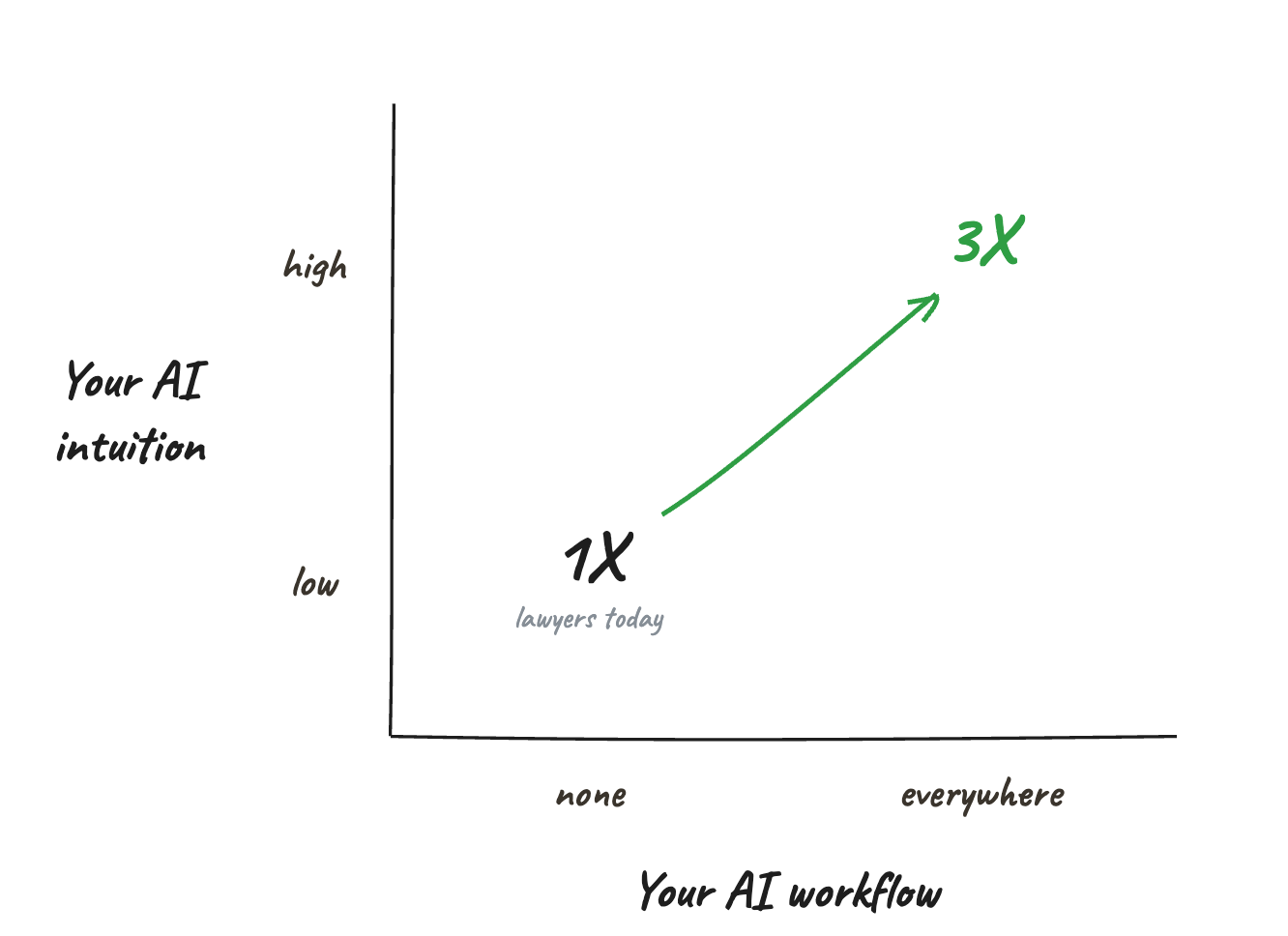
2026 is the year of the 3X lawyer. Given the current state of the tech, if you have strong AI intuition and the right AI workflows (see chart above), we working lawyers can become about three times more productive than before. I admit, there’s no quantitative study here. These are just vibes. My point is that 3X is less than the 10X first advertised. But the gains from AI are real: imagine three of you doing the work.1
Human lawyers are the AI bottleneck, rightly so
After months of being an AI maximalist, I found the clearest answer outside of law, in my personal life.
What does it mean to be an AI-native dad? An AI-native friend or neighbor? I take my daughters to various doctors’ appointments, and I wonder: how much more productive is an AI-native doctor or nurse when they can only see so many patients a day?
The answer is always some version of: sure, it’s a bit better, maybe meaningfully so. But it’s not quite life-changing or revolutionary -- although medicine has a lot of overhead -- and maybe not where it counts either.
AI can plan vacations or transcribe patient notes. It makes you better at the work. But honestly, my kids don’t need a 10X productive father. They need their dad. They want relationship, consistency and trust. AI can’t do any of that.
I see the same with law. My best work happens when I have real relationships with the people I build with. When bad stuff goes down, would my colleagues want to talk to a sycophantic chatbot? There’s a chemistry in trusting someone, knowing that we get one another, that we can talk through problems and work together to solve them.
And when life gets hard, I hope my daughters come to me, not AI. Someone who will listen and be there. Someone who has a track record of showing up in good times and bad. Not someone who is perfect by any means, but someone who cares and is there for them.
We ran this experiment already with remote work. It was efficient. It was also, for a lot of people, very lonely. A coworker is more than a way to pass tasks back and forth. They’re someone you trust.
The 3X Lawyer
Here’s my full picture of AI lawyering in this glorious World Cup summer of 2026.
First, we ought to learn how AI agents work. I call this building AI intuition. We don’t have to learn about KV cache or coding (though I love those topics), but it helps to know the basic facts:
AI agents are like a book-smart junior associate who lacks common sense.
AI agents can lose focus when reading too many documents or following too many instructions. They will not always follow all your rules. They will drift.
AI agents do better when you can build a plan and ask them to check against that. Better yet, use multiple AI agents to check each other’s work.
Second, you become more productive when your AI lives in more places. AI needs the right information to help you and access to where you work. You wouldn’t ask a student to learn but bar them from the library, or a carpenter from the workshop.
For example, say you want AI to help you think through a tough negotiation. It takes time to copy-paste a long email chain with the other side into your AI chatbot. Even more if you have to explain to your AI the background of this deal and attach some supporting documents.
But if your AI can read your email and file folders, that collapses ten minutes of work into one prompt. You can then spend those minutes making sure AI’s analysis is actually good, rather than the pure housekeeping of dragging and dropping files into the right place.
Pound for pound, connecting AI to these data sources is the highest ROI for the typical lawyer, of course assuming you get comfortable with privilege, confidentiality, privacy and security as with any other enterprise tech.
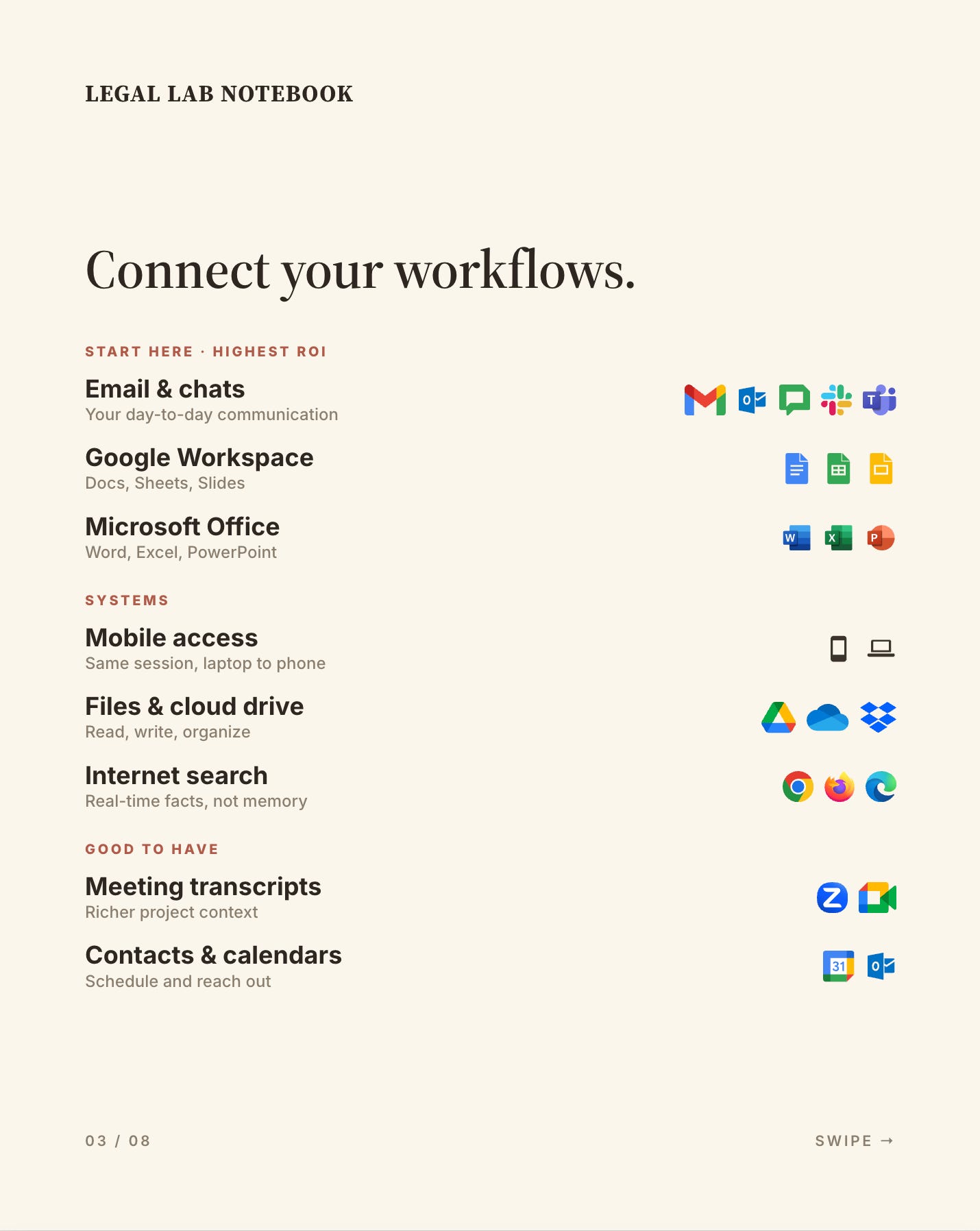
See the full PDF of the field guide.
Start here:
⭐ Email and chats: AI can understand your day-to-day communications
⭐ MS Office or Google Workspace: AI can work where you work, especially Word, spreadsheets and presentations
If I absolutely must pick, I’d start with the above. That immediately nets you savings in time and effort. You can even ditch presentations if you must, since AI generates delightful HTML decks anyway.
Systems:
Mobile access: AI can take your requests whether from a laptop or mobile, ideally syncing the same session history across all devices
File system access on your computer or cloud drive: AI can read, write and organize files
Internet search: AI can search for real-time information and not rely on its internal memory
Good to have:
Meeting transcripts: AI can gather richer context about your projects
Contacts and calendars: AI can schedule events and reach out to others
Then there are specialist sources for teams who need it. Litigation and regulatory may require case law and court proceedings. Patents may require prior-art and patent databases. M&A and corporate may require financial statements, SEC filings and datarooms.
Where AI can do more vs less
Overhead. The routine, repeatable work: moving and renaming files, filling out forms, running a simple contract against a set playbook. My Hermes agent files my CLE certificates from my phone. I email it a cert and it reads the PDF, updates my tracker and running tally, then saves it to my GDrive. Separately, this past week alone AI has helped me sort out my overlapping insurance policies and save down all tickets and itineraries for an upcoming trip.
Thinking. AI is a helpful thought partner and learning buddy. Even if it’s not perfect, its value is in being always available and adaptable to how you learn. This is for a quick gut check before a negotiation. Or when you want to tailor a curriculum for the precise way you learn.
Drafting. AI is good at making rough drafts: emails, summaries, playbooks, simple contracts based on standard templates. The law firm adage goes: it’s always easier to review than to draft. I’ve created nimble AI playbooks on recurring topics I often deal with, and now it’s trivial to ask AI to take a first pass. It’s never the final word. But it saves me 30 minutes here, an hour there, and the savings add up.
Design. Turning dense legal work into a picture a busy executive reads in seconds. A deal that sprawls across a dozen agreements becomes a family tree showing which contract controls. An indemnity buried under an exception to a carve-out becomes a clean matrix of what’s actually covered. Lawyers build careers mastering detail, yet in the real world our biggest value is ruthlessly simplifying.
What it can’t do:
Judgment. An AI model is often like a very zealous junior associate eager to show how smart it is. It will easily spit out the top ten risks in a contract: look, I spotted all the issues! But it can’t tell you which one actually matters or have the experience and context for your day-to-day practice.
Leadership. AI drafts me a great idea and then sits there, a blinking cursor. Even in a world of autonomous agents, AI cannot lead people or will something into being. It waits to be asked. It can give you ideas but cannot bring people together, inspire them and rally them toward a common cause. (At least not in our blissful world of 2026.)
Building things. AI builds only in the hands of a skilled AI user with good workflows. It needs every dependency, API key, package and connector, the plumbing that makes software actually run. This wiring is hard, and it’s why engineers and PMs will still have jobs.
Relationships. It can’t build the ones that make a career. A model can act like a mentor. It can’t be one. Full stop.
I’ve pushed AI as hard as I could this year, and this is where I’m at. Yeah, it’s saved me time, which I’ve ironically plowed back into tinkering with AI. But when there’s a fire at work, my colleagues still come to me, not a chatbot. When my daughters have a hard day, I hope they come to me too. That’s the part AI can’t reach, and honestly, it’s the part I’d never want it to.
Building AI workflows is real engineering, and getting anything to production is very, very hard. Not everyone will have these tools running soon, which is another reason the number is 3X and not higher. That said, if you as a lawyer can add coding to your toolkit, the ceiling is higher. Build your own tools instead of waiting for them, and I’m excited to write more about that topic.