
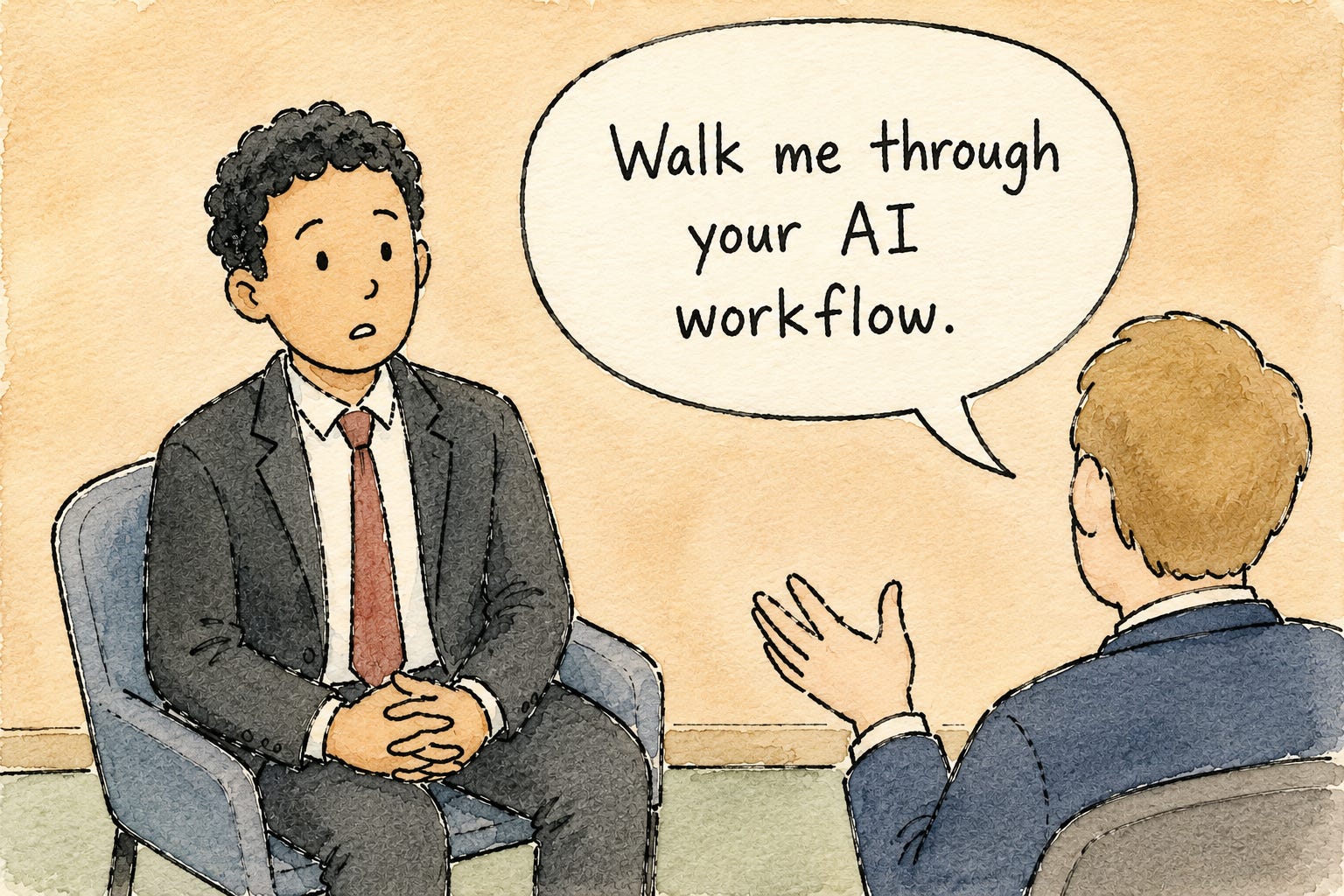
“You’re a great lawyer. How will you use AI to drive even more impact here?”
Imagine a job candidate today who can’t format in MS Word or manage Chrome tabs. The hiring manager wouldn’t even reach the next question. She’d be wondering, quietly, whether the candidate could even read.
The AI question is coming for legal job interviews. I can’t get this Jensen Huang quote out of my head:
“If that $500,000 engineer did not consume at least $250,000 worth of tokens, I’m going to be deeply alarmed. And this is no different than one of our chip designers who says, ‘Guess what? I’m just going to use paper and pencil. I don’t think I’m going to need any CAD tools.’” (my emphasis)
Engineers are already there. Lawyers are next.
AI won’t make a mediocre lawyer great. But AI intuition may separate the great lawyers from the one who gets the offer.
How to approach this question
Anyone can ask ChatGPT to draft an email. But this interview question isn’t asking whether you can run a tool.
It’s asking whether you can do legal work at scale and direct agents to extend your judgment.
The catch is that your AI workflow (from your last job, law school or a side project) will not transfer cleanly to the new job. No enterprise rewrites its stack for one new hire.
What’s portable is the mindset, what I call AI intuition. Employers will want candidates who can speak to the AI setup they’ve built themselves, then walk into a new role and scale using the employer’s AI stack.
Both halves matter. The lawyer with a brilliant home setup who can’t adapt an enterprise stack is no use. The lawyer who knows AI theory but has no actual workflow of her own will have no story to tell.
My mental model of the good answer
How useful an AI is depends less on the cleverness of its model and more on how deeply it sits in the work. A brilliant model can’t help you if it can’t see the documents, the messages, the prior decisions.
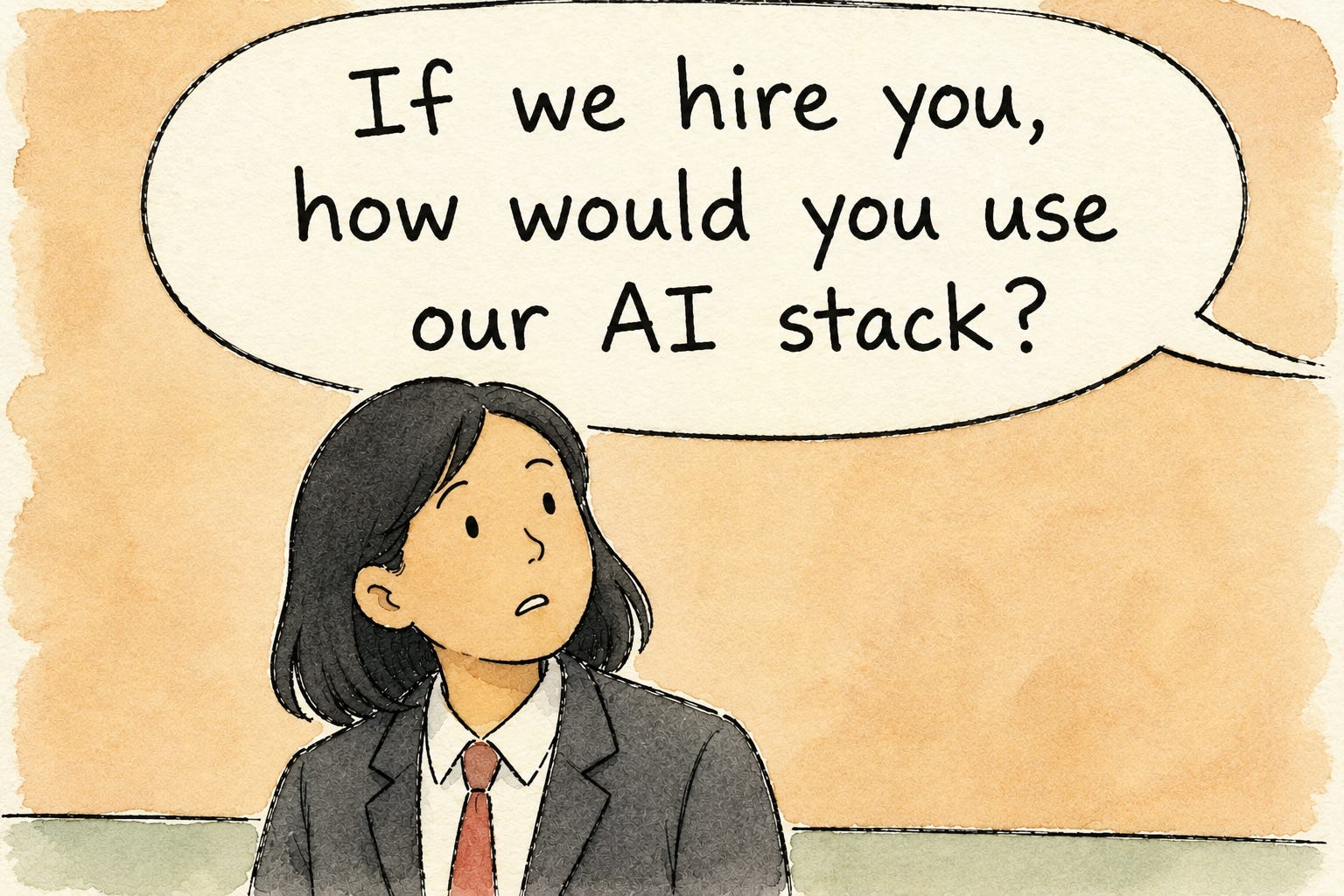
I would frame my answer by mapping out the employer’s AI stack:
1. Does your AI live where the lawyers actually work?
AI needs to sit inside the tools the team uses every day, not as a separate chatbot that requires copy-pasting back and forth. This means places like your chat platform, document editor, contract system, email, browser — where lawyers actually work.
If AI is a tab people forget to open, it doesn’t matter how good the model is. And AI must connect plumbing between those tools as well; otherwise it’s just fragmented software.
In product terms, this is low latency and fast “time to fun”: how quickly can a user start using the product. Ideally, AI is always just a tap or click away (e.g. I keep ChatGPT voice mode on my iPhone lockscreen).
2. Does your AI see the company’s actual knowledge?
Just like your junior associate, your AI needs context to be helpful. AI has to plug into company knowledge that lives in docs, Slack threads, email, redlines and intranet FAQs. Without that context, AI only gives generic answers.
Then there’s the question of retrieval. A useful AI has to find the right source, distinguish current from stale and avoid confidently synthesizing from the wrong material. And it has to do it fast and accurately. That’s a difficult engineering exercise for AI with limited context windows and token budgets.
3. Is the AI just a chatbot or does it take agentic action?
The strongest systems don’t just answer. They track decisions, flag open issues, summarize meeting notes and push drafts back into the workflow.
A junior associate who hands you a memo is useful. A junior associate who hands you a memo, runs a redline, sends the follow-up chat and updates the closing checklist is on another level.
In May 2026, we’re still in the early innings of AI’s agentic era.
4. Does the lawyer actually come out ahead?
The test isn’t whether the AI sounds smart. It’s whether the work product is usable: a draft, a redline, an issue list, a risk assessment, a negotiation position. And whether the time it saves outweighs the time spent prompting it, checking it and cleaning up after it.
A surprising number of AI rollouts fail this test. They look impressive in a demo but don’t create real work in production.
Learn by doing
The strong answer isn’t a single line. It’s a mindset based on AI intuition, and the only way to build that intuition is by experimenting with AI today. If you’ve made an AI workflow and use it day-to-day, you’ll have the war stories that make these questions real.
That’s what will separate the great lawyers from the one who gets the offer.
In a few years this question will sound as dated as asking whether you can use a computer. Until then, start building AI intuition.