
Note: I’m phasing some live AI bootcamps to recorded videos, which I hope is easier for scheduling and watching! Comment below or reply to this email if you want to learn about a topic.
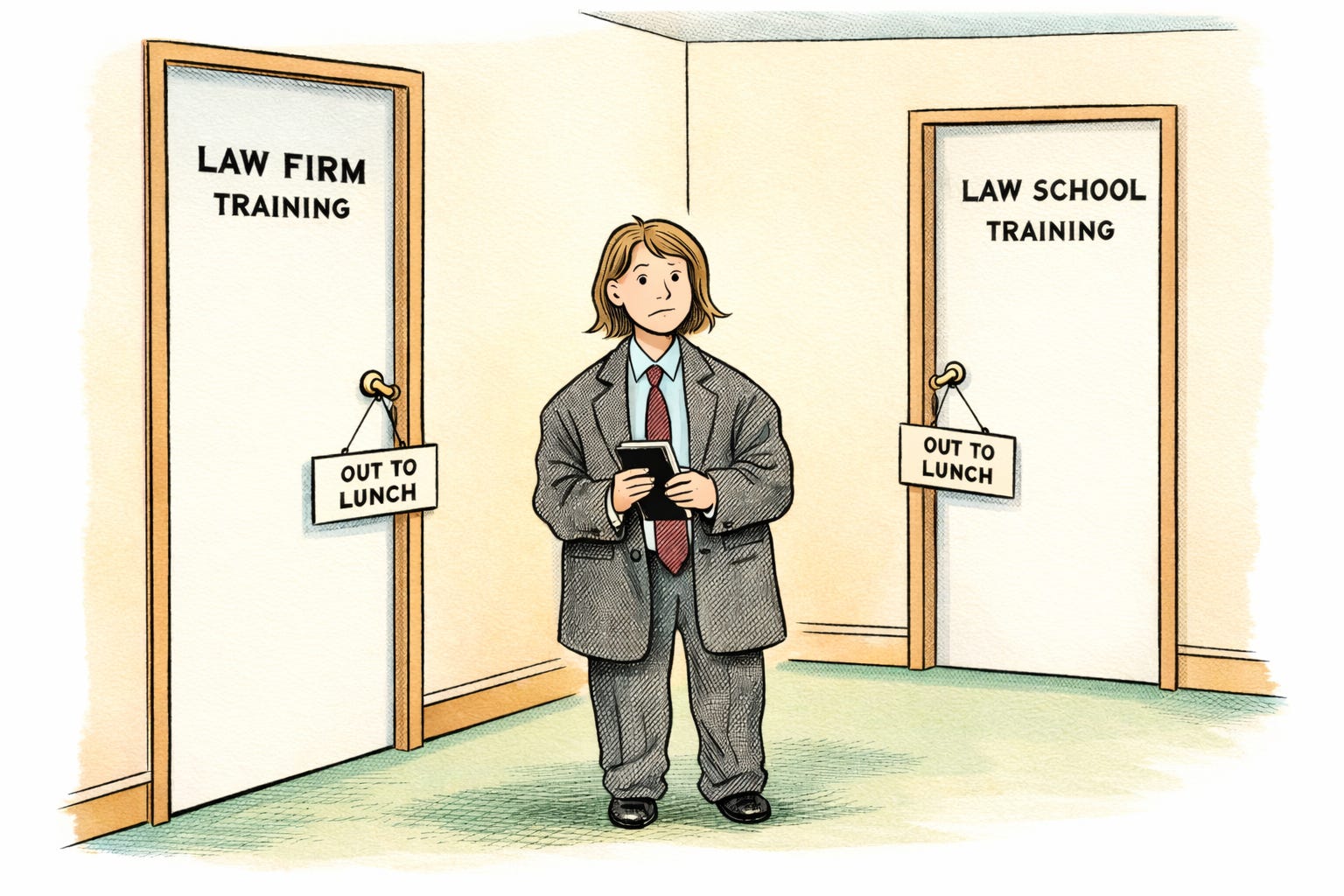
Law firms with AI will stop training junior lawyers. That’s the mantra now.
AI does the grunt work cheaper and faster. Senior lawyers have no incentive to invest in new grads.
Assume they’re right. The next question is the interesting one: if firms won’t train you, who will?
Law schools are the obvious answer. Three years, $300,000 and a mandate to guide young people in a time of disruption.
It won’t happen.
Not because law schools aren’t valuable. I valued mine. But the incentives point the wrong way.
Law students must take matters into their own hands. Not to use AI as a crutch or to outsource their judgment to a machine, but to use AI to make themselves sharper, faster and even more marketable.
The law school business model
When Christopher Columbus Langdell reshaped legal education at Harvard in 1870, he made a deliberate choice: strip the practical training out.
America was industrializing. Railroads and factories made for complex commerce, which meant we also needed lawyers at industrial scale. This was the same pressure that later drove Paul Cravath to build the associate model at his law firm.
Langdell’s answer was the case method: one professor, 150 students, a lecture hall and a casebook the professor wrote. Academic, pure, walled off from the mess of practice.
This teaching style has merits. But it also happened to be a spectacularly efficient business.
No laboratories, no clinical equipment, no specialized facilities. Law schools produce fleets of young lawyers at scale, running on margins that subsidize entire universities.
Practical training demands the opposite. Clinics and workshops need small groups, more faculty. Professors need to give weekly feedback on assignments, not just a single final exam. Every hour spent grading is an hour not spent on publishing academic papers that earn tenure.
The ABA compounds the problem. It mandates a third year the profession openly admits adds little, piling on tuition, living expenses and foregone wages and career growth. It also screens out anyone who cannot afford three years away from paid work.
The institution that taught you to think like a lawyer wasn’t built to teach you to practice like one. Adding even management training and soft skills to the curriculum has proved hard enough. Adding AI, a genuinely new way of working, is a stretch I do not believe law schools can make.
Law firms used to pick up where school left off. That side of the bargain is fraying too.
Which is why the work falls on you.
Your studies, augmented by AI
Look at engineering to see how this could end up. Jensen Huang said he’d be deeply alarmed if a $500,000 Nvidia engineer does not spend at least $250,000 in AI tokens every year. He compares an engineer who passes up AI to a semiconductor chip designer who insists on paper and pencil over CAD tools.
The lesson for lawyers is not the dollar figure. It’s that engineers have reorganized knowledge work around these thinking machines — machines that generate not widgets but units of intelligence. Law is next in line. No one in your classroom was hired to prepare you for it.
Two questions every law student should sit with:
Workflow: for any task I take on, can I do it better or faster with AI?
Thinking: can AI make me a sharper thinker, not just a faster worker?
A few ways to train:
Revise a contract by hand. Then hand the same assignment to AI, loaded with your context. Compare the two line by line. The gap between them is where the learning lives: what you missed, what AI missed, what you would do differently on a second pass.
Run diligence on a 200-document data room the old way. Read every file, scan for red flags, log the issues, ladder up from ground level until the deal-breakers surface. Then point AI at the same room and see what else it catches. You will find patterns you missed (and patterns AI invented).
Draft your strongest motion or brief. Then flip sides. Use AI as opposing counsel. Ask it to be brutally honest. Let it pressure-test your reasoning to make it even stronger.
Each of these exercises builds AI into the way you work and think, rather than grafting AI onto old habits. In this era, learning AI is not prep for legal practice. It is the practice.
One strong caveat. AI augments; it does not replace. A lawyer’s north star is not raw output, but judgment: spotting the issue, framing the argument, pressure-testing the reasoning. The lawyer who cannot do those has nothing worth augmenting.

No generation of lawyers before you has had tools like these. Your law school won’t teach you to wield them. Your firm may not either.
Take it into your own hands.